About
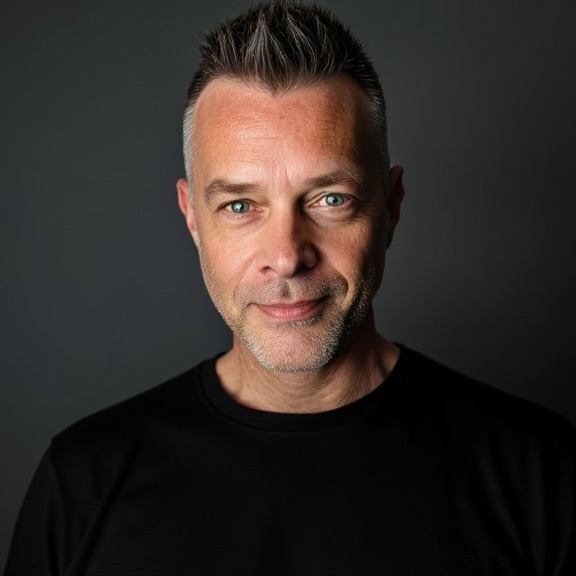
I've only ever designed one thing: the user's experience. Not how a product looks, but how it affects the person using it, and how that makes them feel about the product, and by extension the brand. Print, then web, then full campaigns, then product software, now AI. The surface kept changing. The job never did: how does this make someone feel, and is that the feeling you intended?
Each stage taught me something the next one needed. Agencies taught me that experience is a promise kept at every touchpoint. Enterprise software taught me what a wrong number costs, and that a powerful product nobody can use is not a product yet. AI is where both lessons are being tested at once.
The work has two halves I don't separate. One is deciding what a product should be for the person using it, and making that decision tangible enough to argue with. The other is developing a design team whose judgment can carry those decisions, with me and without me.
The arc
I founded a design firm that won national awards, then ran creative at agencies, accountable for how a brand felt at every touchpoint. A second firm followed, with clients including Sony, Mattel, and Epic Systems. Then product: enterprise and consumer software across analytics, licensing, and media. Today I'm Senior Director of Product Design at Conviva, where I lead a globally distributed design team and design for the platform's AI assistant.
Philosophy
I lead by making room: a clear brief, real autonomy, and a standard that is written down, so judgment can stay with the person doing the work.
How I lead
When we moved design work out of Figma and into coding agents and a terminal, designers lost the canvas they'd always compared ideas on. That was a real loss, and I treated it as one. I worked alongside them on ways to get comparison back, and they went on to build their own dashboards to track and show their work. I don't prescribe the artifact. I ask each designer to choose what will communicate the idea to the audience in front of them, and I'm in the conversation when they want me there.
The example I'd point to first is a principal designer I hired in Beijing. I gave her an unfinished proposal for how our design system should work for AI agents. She caught errors in it, extended it, and saw an application I'd missed. Her judgment changed the proposal, and her revisions are in the design-system architecture we build on now. The second is a senior designer on my team who is first author on a CHI paper our chief scientist and I set in motion. Our chief scientist set the direction and the research team carried the paper; I matched the design work to his strengths, and the interactive design the paper shows is his.
Affiliations
- UC Riverside Design Thinking Advisory Board
- Lexus North America Advisory Board
- OpenAI Forum, member
Publications
- How to Lead Design in the AI Era (2025). ai-plus.design
- BiModal Design, an open framework for interfaces that serve humans and AI agents. bimodal.design
- ACM CAIS 2026, the inaugural ACM Conference on AI and Agentic Systems: contributing author; I authored the explainability layer, the part that lets analysts verify machine-surfaced insights. DOI 10.1145/3786335.3813185 · open access
- ACM CHI 2024, SEAM-EZ: Simplifying Stateful Analytics through Visual Programming: co-author; the first author is a senior designer on my team
- U.S. patent application US 2025/0086662 A1, named inventor, pending
Awards
- 100+ national design awards
- Best Data & Analytics Innovation, CSI Awards 2023 Conviva, Experience Insights
Continuing education
- MIT · Systems Thinking (online course, 2025)
- MIT · Ethics of AI Bias (online course, 2024)
Elsewhere
If you're thinking about design leadership for a complex product, or about how a design team develops as its tools change, I'd like to talk.